

MSI X570 Tomahawk Motherboard Review
Today nosotros're taking a look at MSI'due south new X570 Tomahawk motherboard. We've been neat to exam this thing out for months now as this is a very of import board for MSI. Non just does it mark the next stop in their X570 "redemption" tour, but at $200, information technology'south a mainstream board many of you will be interested in.
Up until now, MSI's offer at $200 has been the X570 Gaming Edge WiFi, a lath that failed our Ryzen 9 3900X VRM stress test. Making matters worse, no other make failed that test at any price point. Those of you lot who have been post-obit our X570 VRM thermal testing will know what we remember of MSI's A Pro, Gaming Border, Gaming Plus and Gaming Pro Carbon... in terms of VRM performance they're all pretty lackluster.
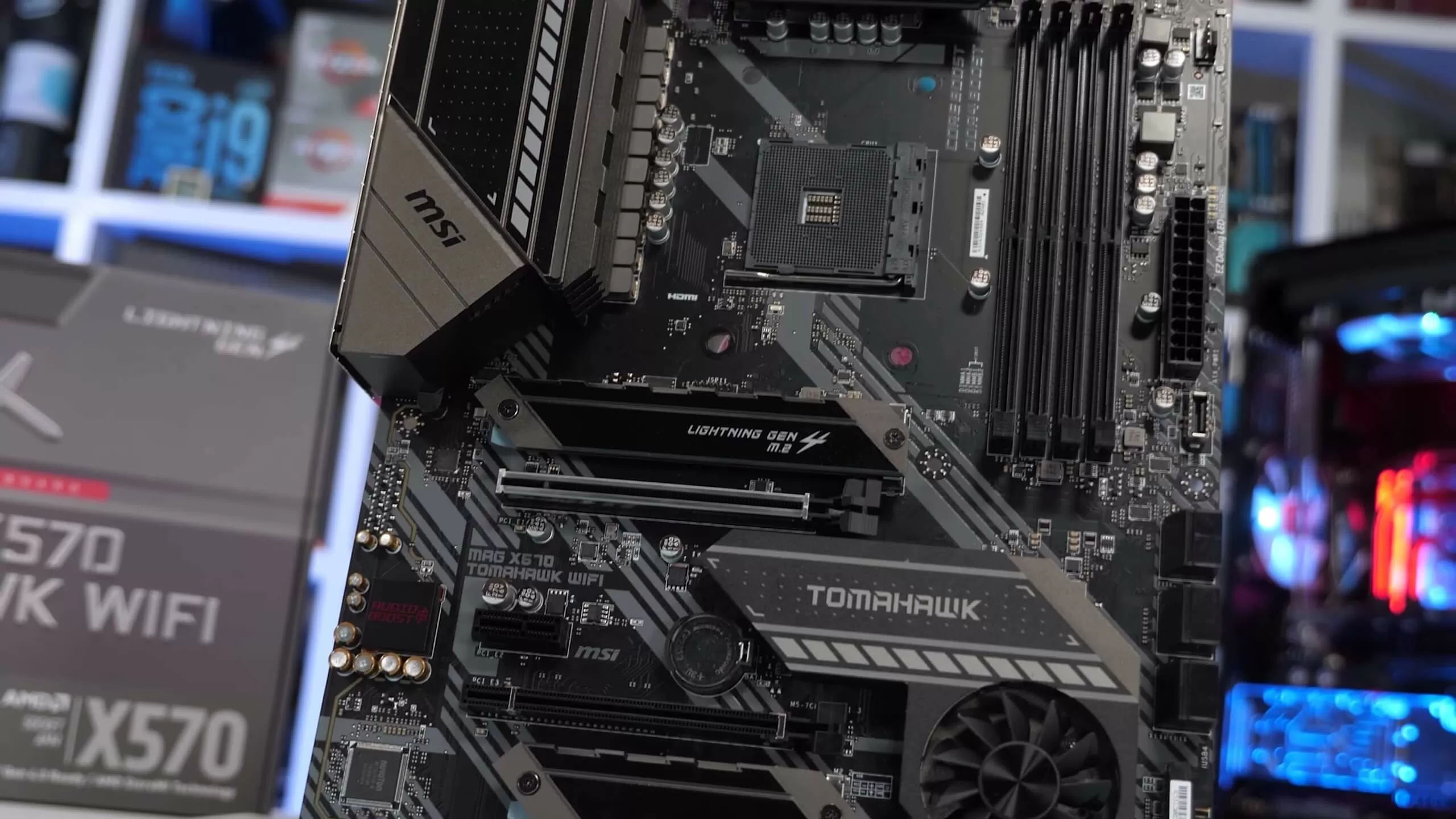
Albeit they needed to do better, MSI has been working on rehashing their lineup. Start they replaced the $370 Ace Gaming with the the $300 Unify, stripping abroad the RGB lighting for a no frills affair. The X570 Unify is a keen quality lath, but at $300 it'south out of reach for many.
This is where the MSI X570 Tomahawk comes in and at $200 it's going head to caput with pop X570 mainstream boards such as the Asus TUF Gaming Plus, Gigabyte Aorus Aristocracy and Asrock Steel Legend. Moreover, it volition be replacing the horrible Gaming Edge WiFi, a board nosotros really hope MSI discontinues, along with a few others including the X570 Pro Carbon.

We don't program to make a thorough review of every attribute of the Tomahawk (encounter a full list of specs here), nosotros've already tested over a dozen AMD X570 motherboards, and our recommendations can be found in the corresponding buying guide.
Our main focus will be on testing VRM thermal operation as this is a central differentiator among these motherboards that will house a powerful new generation Ryzen processor. The VRM is not something that can exist easily upgraded either. Only before we spring into that, nosotros should annotation that the Tomahawk does offer some new features over the Gaming Edge such as ii.5 Gbit networking, an additional USB 3.2 Gen two USB port and the Wi-Fi has been upgraded to Intel Wi-Fi six AX200 with Bluetooth v.0. Other than that, it'south very like to what nosotros saw earlier in terms of pattern, VRM excluded, of course.


Moving on to talk almost the VRM configuration, the X570 Tomahawk uses the ISL69247 controller of which 6 signals are taken for the vcore portion of the VRM and and then doubled using ISL6617 stage doublers. Those 12 phases then connect to the stars of the show, a dozen ISL99360 60A ability stages. In the previous Gaming Border WiFi, MSI used an Infineon IR35201 controller with four signals for the vcore VRM, each doubled using an IR3598 phase doubler.

By default MSI uses a 500 KHz CPU switching frequency for both boards and Buildzoid calculates that at 1.2v with a 200A depict the Gaming Border VRM puts out 46 watts of heat and that would explain why these boards run so hot given a 3950X will pull effectually 170-190A with PBO enabled. Meanwhile Buildzoid too calculates that the new Tomahawk board volition generate but 17 watts of heat under the exact same conditions. That's over a 60% reduction in thermal output.

Looking at competing boards such as the Asus TUF Gaming X570-Plus and Gigabyte Aorus Elite, those boards both utilize a dozen Vishay SIC639 50A ability stages which are basic DRMOS components with basically no current or temperature monitoring. The smart ability stages used by the Tomahawk feature electric current and temperature monitoring, and so of course they're rated for 60A, so will back up college currents.

The Tomahawk features a similar heatsink design to that of the Gaming Edge, only that'southward fine since that was not what let the Gaming Edge downwardly, rather information technology was the junk under it. On paper the X570 Tomahawk looks dandy and there's no reason why this shouldn't be by far the best $200 AM4 motherboard period. For now, let'due south move onto the testing.
Benchmarks
For load testing we're running the Blender Gooseberry workload for an hour on an open air test bench with no direct air flow. Normally nosotros also test inside a PC case but for the X570 testing we skipped this step equally the programme was to re-test over 20 X570 motherboards once the Ryzen 9 3950X was released. As it turned out, the 3950X was no more power demanding than the 3900X, so a re-test wasn't warranted.
To record the temperatures we're using a digital thermometer with Chiliad-Type thermocouples and we're reporting peak MOSFET surface and rear PCB temperature. For the MOSFETS this means we're measuring the temperature directly on top of the component, between it and the thermal pad and not the internal temperature which is bound to be a niggling higher. Nevertheless with all boards tested nether the verbal aforementioned weather condition that will give us a clear picture of how the VRM temperatures compare.
Finally nosotros're not reporting Delta T over Ambience, instead we maintain a room temperature of ~21 degrees. We accept a thermocouple sitting next to the test system monitoring room temp.
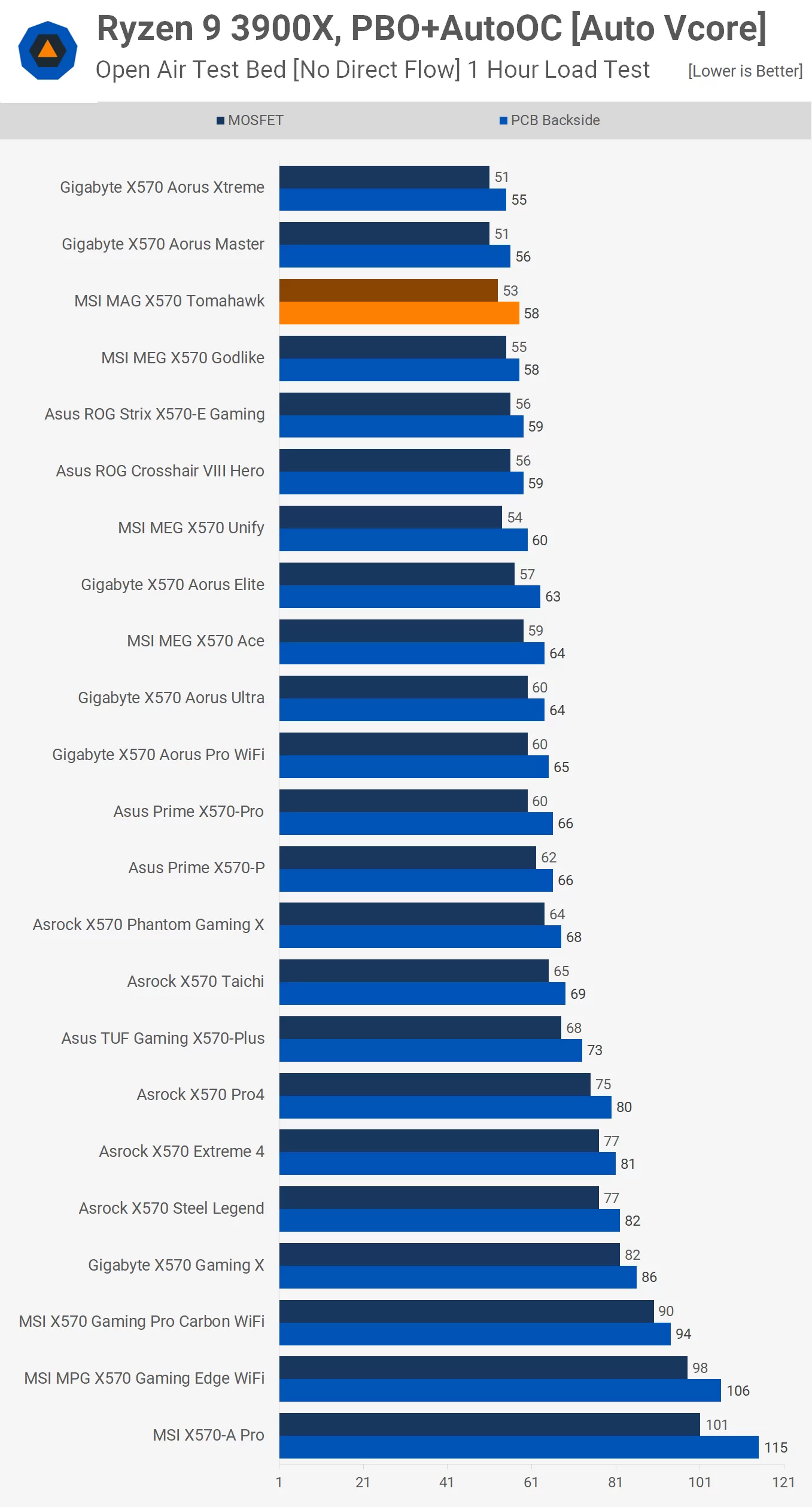
Here'southward our first set of results using the Ryzen 9 3900X with PBO+Auto OC enabled in the RyzenMaster software. After the 60 minutes-long stress examination the X570 Tomahawk peaked at just 58 degrees which is an incredible result, that's basically the kind of functioning you can wait to come across from the very best X570 motherboards. In fact, information technology's 3 degrees cooler on the MOSFET when compared to the Asus Hero, a board that costs twice every bit much. It's also able to friction match MSI's own $700 Godlike. Basically it's ii-three degrees warmer than the very best X570 motherboards.
When compared to the Gaming Edge, the board the Tomahawk is replacing, we meet a 48 degree drib in PCB temperature. Information technology's also xv degrees cooler than the TUF Gaming and 5 degrees cooler than the Aorus Elite which performs very well nether this load.
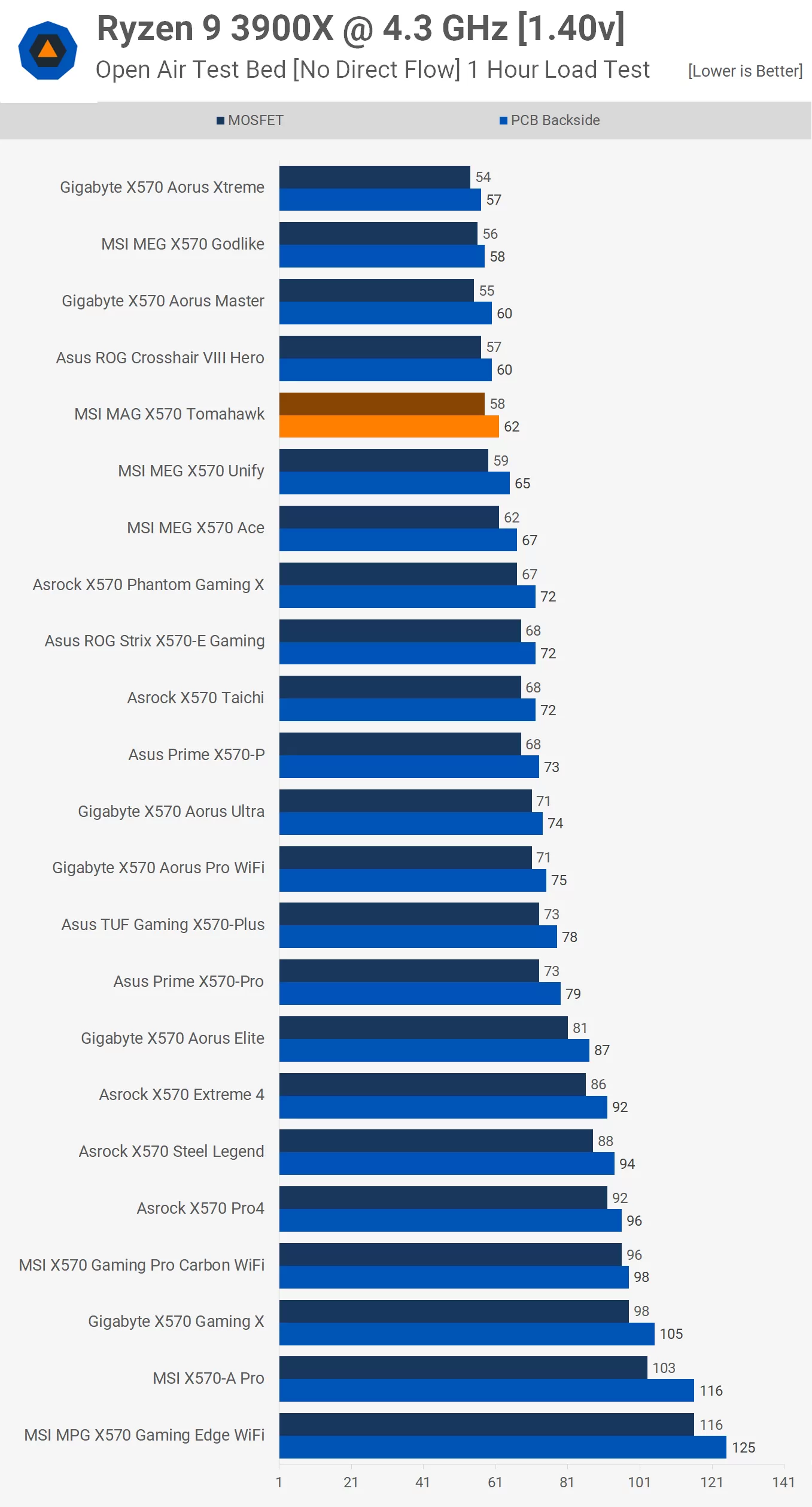
Moving on to the overclocked results with the 3900X at four.3 GHz using i.4v, previously nosotros institute that the Gaming Border, A-Pro and Gaming Pro Carbon all failed this test. The same applied to the Gaming Plus. The VRM on these boards simply got too hot and as a result the 3900X began to throttle. As you tin can see the temperatures at which these boards throttled were all quite different, the near high-stop of which, the Gaming Pro Carbon, didn't even hitting 100 C.
The X570 Tomahawk on the other paw maxed out at just 62 degrees, a mere 4 degree increase from the PBO test. This meant the Tomahawk was a degree cooler than the Unify when comparison driver temps and 3 degrees cooler when comparison the PCB temperature. It also meant the Tomahawk was just four-5 degree warmer than the very best X570 boards, which is an amazing improvement for this new $200 motherboard.
It's also a significant improvement over the Asus TUF Gaming which is one of our favorite X570 motherboards at this cost point. The Tomahawk lowers the PCB temperature past an incredible 16 degrees over the TUF and that also makes it 25 degrees cooler than the Gigabyte Aorus Elite. We believe the Aorus Aristocracy cooler tin't handle the thermal output as well as the TUF cooler in this test, which is why it performs much worse than what we saw in the PBO testing, some direct air flow would likely bring these boards closer together.
Moving past the Asus and Gigabyte boards, mayhap most important of all is the 63 degree drib in PCB temperature from the horrible Gaming Edge WiFi.
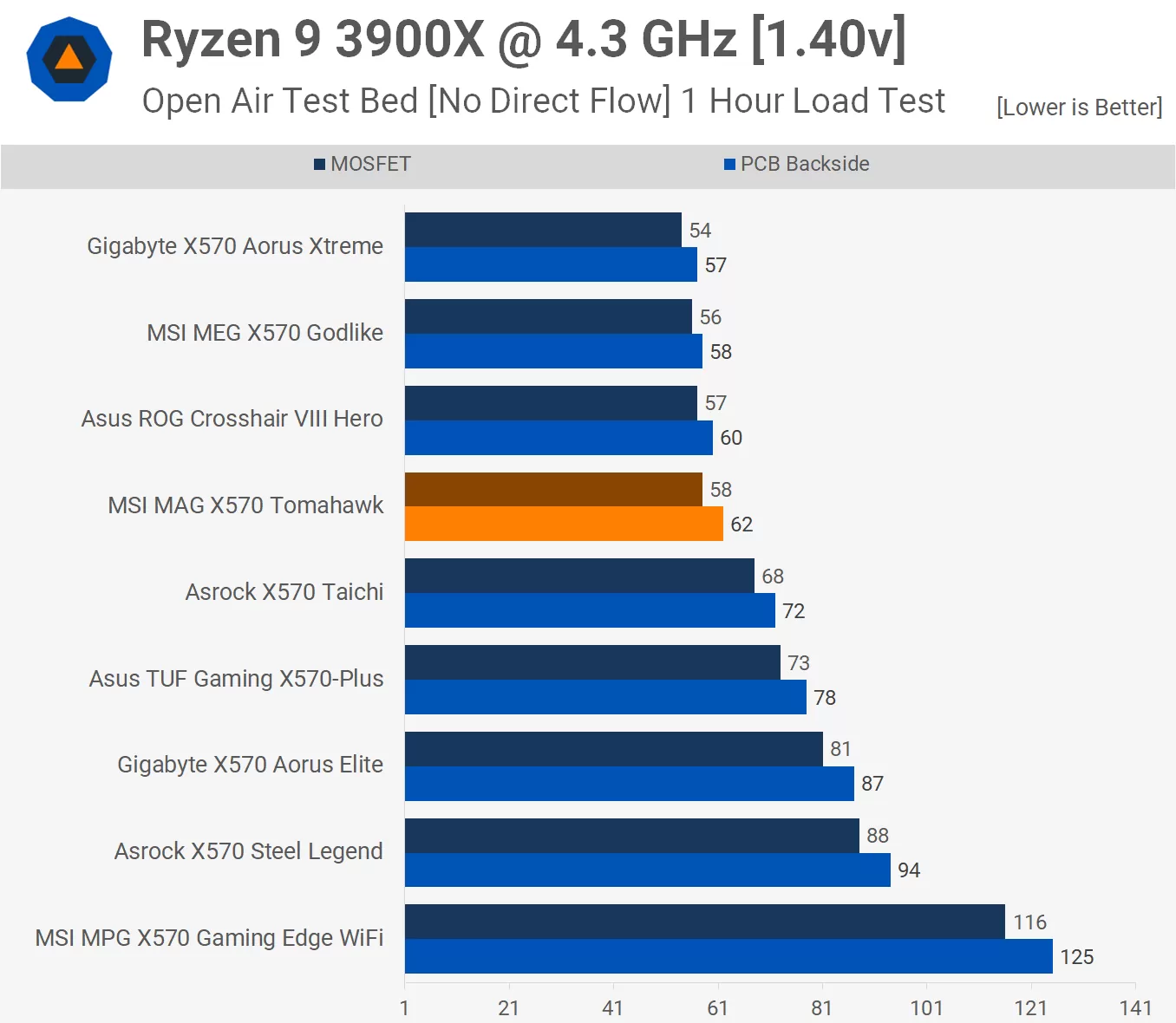
Here's a look at the Tomahawk versus its directly competitors at the $200 cost point forth with the flagship models from Asrock, Asus, Gigabyte and MSI for reference. This paints a articulate picture of simply how skillful the Tomahawk is, we're getting flagship VRM thermal performance for $200.
As practiced as the Asus TUF Gaming X570-Plus is, it can't compete with the newer Tomahawk. It's just a shame we had to wait virtually a twelvemonth to get a adept MSI X570 board that won't cost over $300.
What to Purchase, Wrap Up
MSI's new Tomahawk is the most impressive X570 motherboard we've tested at this price point. Like we only said, it's a shame we had to look and then long. MSI certainly didn't get it correct the first time, just so far the do-over at a few different cost points is working out slap-up.
The MSI X570 Unify offers the best VRM operation at $300, and yet the more than affordable Tomahawk is fifty-fifty better in this respect. Unless you're willing to spend $700, in that location'due south no beating the Tomahawk in terms of VRM thermals. In fact, you could say the Tomahawk's VRM is overkill, which nosotros certainly won't object to, merely one time yous start to push below 90 degrees in our 4.3 GHz OC examination, for the vast bulk of users, it won't thing. All sub-xc degree boards will piece of work only fine with an overclocked Ryzen nine 3950X, even in hot environments, peculiarly if yous're merely gaming.

Compared to existing MSI models, the Tomahawk obliterates boards like the X570 Gaming Pro Carbon WiFi, it'southward but better in every conceivable way. Nosotros also hope MSI decides to discontinue the Pro Carbon already, the matter is an embarrassment.
If you're deciding to buy between the X570 Tomahawk, TUF Gaming, Aorus Elite or even the Steel Fable, it won't make much of a divergence as all will work fine with any high-stop AM4 processor. If you're an overclocker, the Tomahawk does offering an advantage but otherwise the feature set amongst these boards is rather similar.

The Asus TUF Gaming X570-Plus WiFi has been our go to choice at this price point for almost a twelvemonth now -- information technology'southward currently available for nigh $190. The Tomahawk has the advantage of being the newer, more polished offer now, and it did run 16 degrees cooler in our OC testing, merely with the TUF peaking at merely 78 degrees there is no way you lot're going to run into any VRM issues on this board.
Bottom line, if you're ownership an X570 motherboard today and you lot have the Tomahawk bachelor at $200, that'south the obvious option unless the Asrock, Asus or Gigabyte alternatives are on sale at lower prices. Now we only need to expect and see the Tomahawk go on sale, that should happen early adjacent month.
Shopping Shortcuts:
- MSI X570 Tomahawk on Amazon
- Asus TUF Gaming X570-Plus on Amazon
- Gigabyte X570 Aorus Elite on Amazon
- Asrock X570 Steel Legend on Amazon
- MSI X570 Godlike on Amazon
- AMD Ryzen ix 3950X on Amazon
- AMD Ryzen 9 3900X on Amazon
- AMD Ryzen nine 3700X on Amazon
- AMD Ryzen v 3600 on Amazon

Source: https://www.techspot.com/review/2020-msi-x570-tomahawk/
Posted by: bohnnesecale.blogspot.com
0 Response to "MSI X570 Tomahawk Motherboard Review"
Post a Comment